

It’s been a head spinning few weeks in Maine’s U.S. Senate race.
A pro-Susan Collins super PAC, Pine Tree Results, launched an early $2 million ad campaign attacking Democrat Graham Platner with more than a month to go before the U.S. Senate primary.
Maine Governor Janet Mills, out of money and trailing Platner in the polls, announced she was suspending her primary campaign.
Later that same day, in Washington, Susan Collins voted with the Democrats for the first time on a resolution to halt the war with Iran.
It’s gotten me thinking about how to best understand where the race is right now, how it got here, why it’s different from Senator Collins’s past reelection campaigns and where it may be headed.
Democrats must win this race to have any hope of regaining the Senate majority. Republicans need it to hold on to the upper chamber.
For the Democrats, it’s a tough assignment against a tough opponent, even in a year with a much younger, progressive challenger drawing large enthusiastic crowds across the state, and where so many key indicators point towards a political environment favoring Democrats.
In 2014, I spent an entire day riding around on a bus with Susan Collins.
News managers at Maine Public Radio, where I was a reporter, had assigned me to profile the senator as part of our election coverage. Collins was running to serve a fourth term in the senate against another political newcomer at the time named Shenna Bellows, Maine’s current secretary of state and a candidate for this year’s Democratic gubernatorial nomination.
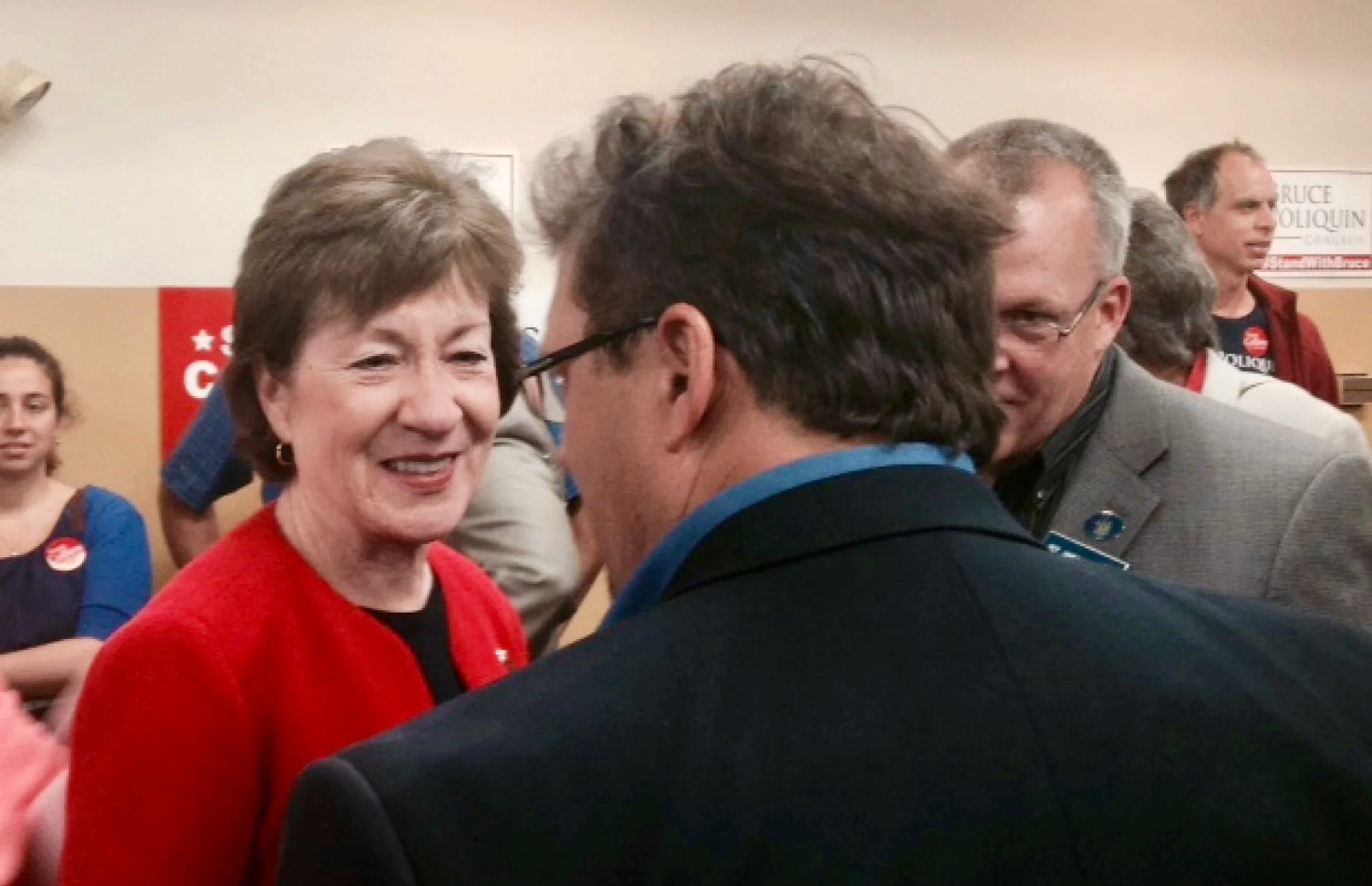
I met Collins, several staffers and other media that early August morning in Bangor, where we boarded her campaign bus. The itinerary for the swing followed a campaign blueprint Collins has used successfully in her races over the years: prearranged visits to businesses run by supporters, many of which have benefitted from federal funding the senator has delivered or pieces of legislation she’s helped to pass. The first stop on the 2014 trip was at a local market twenty minutes outside of Bangor. After arriving to cheers and greetings from the store’s owners and supporters assembled out front, Collins had a series of interactions that still speak, 12 years later, to a political identity she’s cultivated carefully and used effectively in Washington and in her reelection campaigns.
In the spring of 2014, Collins’s approval rating stood at 79% in Pan Atlantic’s annual Omnibus Poll. She went on to win reelection in a rout that November.
A little over two years later, in August of 2016, Collins wrote the op-ed that would foreshadow the difficult road ahead for her in holding together the coalition central to her brand and electoral success back home.
“My conclusion about Mr. Trump’s unsuitability for office is based on his disregard for the precept of treating others with respect, an idea that should transcend politics. Instead, he opts to mock the vulnerable and inflame prejudices by attacking ethnic and religious minorities. Three incidents in particular have led me to the inescapable conclusion that Mr. Trump lacks the temperament, self-discipline and judgment required to be president.”
“Some will say that as a Republican I have an obligation to support my party’s nominee. I have thought long and hard about that, for being a Republican is part of what defines me as a person. I revere the history of my party, most particularly the value it has always placed on the worth and dignity of the individual, and I will continue to work across the country for Republican candidates.”
Susan Collins, Washington Post, August 8, 2016
What Collins didn’t say was how she would continue to appeal, in the event of a Trump victory, to the pockets of unenrolled voters and centrist Democrats who had supported her in her past races.
In 2017, Collins cast a key early vote helping to defeat a bill to repeal the Affordable Care Act, but later that year supported the 2017 Tax Cuts and Jobs Act, which eliminated the individual mandate requiring most Americans to purchase health insurance under the ACA.
Later passage and funding of separate legislation to stabilize the health insurance market and keep premiums low never materialized, despite promises made to Collins by GOP Senate leadership and the Trump White House in exchange for her support for the tax cut bill.
In 2018, Collins, who holds a pro-choice stance on abortion, voted to confirm Justice Brett Kavanaugh to the Supreme Court in a 40-minute speech on the Senate floor.
“Noting that Roe v. Wade was decided 45 years ago, and reaffirmed 19 years later in Planned Parenthood v. Casey, I asked Judge Kavanaugh whether the passage of time is relevant to following precedent. He said decisions become part of our legal framework with the passage of time and that honoring precedent is essential to maintaining public confidence.”
Kavanaugh later voted with the majority in Dobbs v. Jackson Women’s Health Organization, overturning Roe v. Wade and Planned Parenthood v. Casey, eliminating the constitutional right to an abortion.
From a pure political perspective, the rise of Trump put historically moderate Republican senators like Collins, already a dying breed, in a bind. On these consequential issues and many others, it had become increasingly difficult for Collins to satisfy all parts of her political coalition back home on every legislative vote or judicial or cabinet confirmation.
It’s important to note here that there’s longstanding disagreement by some in political circles in Maine and beyond about the true authenticity of the political identity Collins has carved out in her years in the U.S. Senate.
By early 2020, the pandemic was raging. Daily life had been turned upside down. Voters across the nation seemed poised to punish incumbents at the polls. Susan Collins’s approval ratings were underwater. And Democrats in Maine and Washington D.C. saw a historic opportunity in the candidacy of Sara Gideon, Speaker of the Maine House of Representatives, to defeat Collins and retake the majority in the U.S. Senate.
The race became the most expensive political campaign in Maine history with Gideon spending $48 million and Collins $23 million. Gideon led in every single poll throughout the cycle. And on election day, Collins defied the odds and cruised to a comfortable 8-point win, outperforming Donald Trump’s vote share in his defeat and making Maine the only state in the nation to elect a GOP Senator in 2020.
What helped Collins pull the race out and what does it tell us about the 2026 U.S. Senate campaign underway in Maine?
In 2020, Collins went all out to get voters to focus on her Maine roots and lifelong allegiance and service to her home state, as compared to the out-of-state background of her opponent. Sara Gideon grew up in Rhode Island and moved to Maine in 2004. Collins ran ads attacking Gideon for her left leaning positions, her voting record in Maine and unpaid taxes tied to property in Freeport.
Gideon countered that Collins had transformed from a moderate Republican problem solver into a far-right rubber stamp for Donald Trump’s extremist policies and appointees.
Gideon had the support of every key part of the establishment, including the Democratic Senatorial Campaign Committee, labor unions, women’s groups and the endorsement of former President Barack Obama.
What the 2020 exit polls made clear was that Collins had been able to successfully reassemble her electoral coalition of conservatives and moderates, despite polling suggesting otherwise.
Labeling Gideon as “from away” in the minds of enough voters also dovetailed with efforts to get them to see her as a tool of the Democratic establishment in Washington, and as an inexperienced legislator who would deprive Maine of the advantages that come with having Collins on the Senate Appropriations Committee.
All senators are eager to tout the resources they bring to their home states. Anyone who has worked as a reporter in Maine over the past 30 years has covered events where Collins appears, with other members of Maine’s Congressional Delegation, to celebrate federal funding awards.
Collins puts extensive planning and advance work into these kinds of appearances, as I saw first-hand while working for TimberHP during the company’s early startup phase. Prior to our groundbreaking ceremony at the Madison mill in July of 2023, I was responsible for planning sessions with members of the delegation who had helped secure early US Forest Service funding for the company and would be speaking at the ceremony. In multiple calls with Collins’s staff, I gained a different appreciation than I’d previously had of how important these funding awards and events are, both practically and politically, to the Senator.
Collins became chair of the Senate Appropriations Committee when Republicans took control of the Senate in 2024. In February of this year, the Bangor Daily News published an op-ed piece by Collins, looking ahead to the campaign.
Now, as chair of the Senate Appropriations Committee, I have the power and determination to fight even harder for Maine. Last week, we achieved something Congress hasn’t accomplished in years when nearly all the annual federal funding bills that went through our committee were signed into law. This required hard work and long hours, but it will benefit Maine by delivering $425 million, this year, to improve hospitals, fire stations, workforce programs and many other projects. In the past five years, I have secured nearly $1.5 billion in congressionally directed spending that is being invested in more than 650 community projects in all 16 counties.
Collins’s campaign is leaning heavily into the argument that what the senator delivers for Maine—from her perch atop the appropriations committee—is not easily replaceable. It’s the main thrust of her campaign’s advertising with spots touting everything from funding for diabetes and cancer research to support for new firefighting equipment in rural towns to multimillion dollar technology and growth investments in key heritage industries. The ads are heavy with testimonials from voters vouching for the impact these efforts have had on their lives.
Collins appears to be counting on her ability to run a similar campaign to her successful 2020 race, with a few tweaks. But that may prove to be difficult. Donald Trump’s approval is at record low levels in recent polling. Voters blame him and his party for an unpopular war, high gas prices, persistent inflation, tariff-induced economic uncertainty, rising health care costs, corruption in the White House and an overall environment of chaos and incompetence.
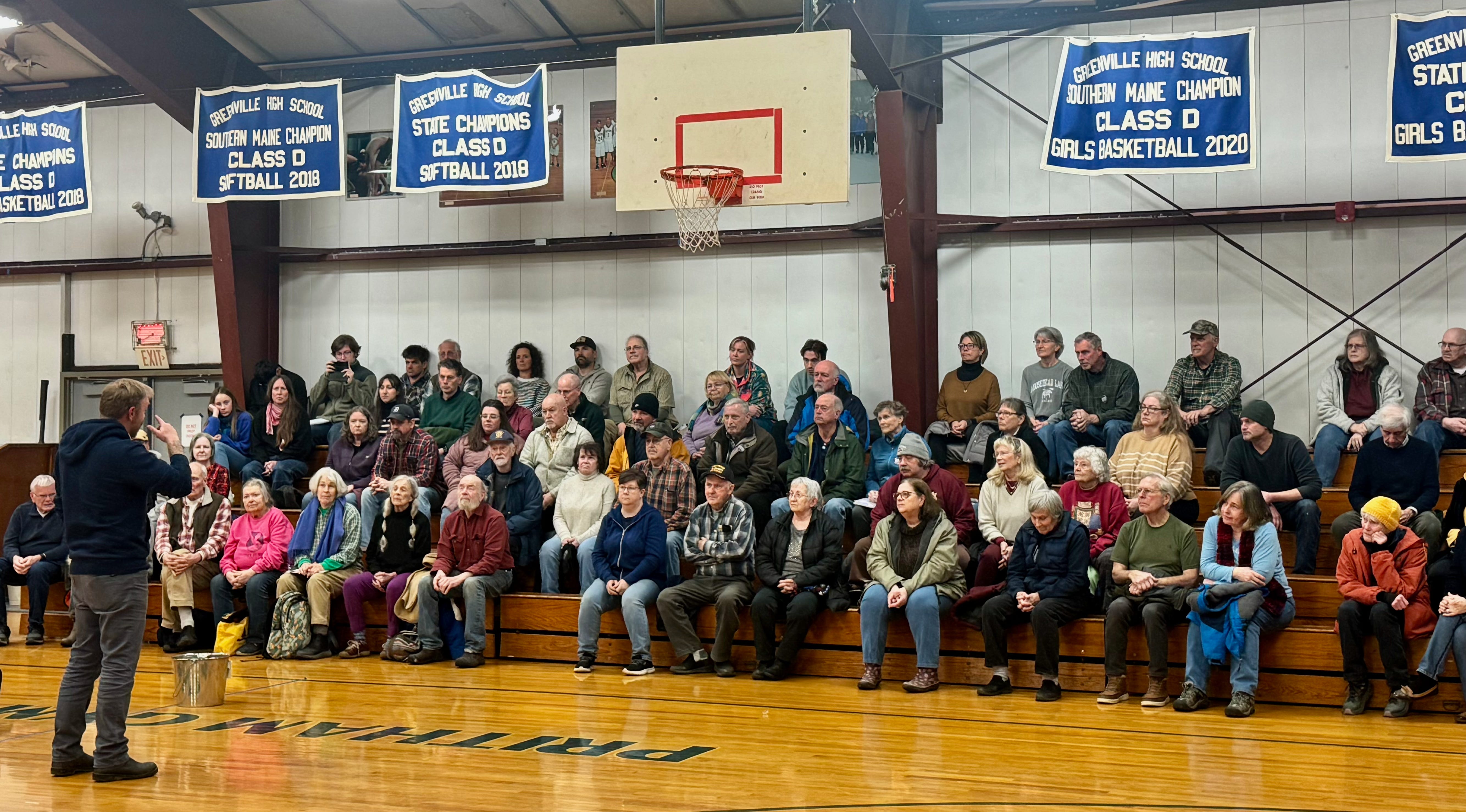
And in Graham Platner, Collins has an opponent unlike any she has faced before. A combat veteran and Maine native, who has come out of nowhere to lead a political movement that’s drawing large crowds, national attention, money and enough momentum to force the Democratic Party’s handpicked candidate, a two-term sitting governor, from the primary before a single vote was cast.
How the following issues play out will likely determine who wins in November.
The Iran War
The president launched a war with Iran that has proven to be deeply unpopular with the American public. Senator Collins voted multiple times against war powers resolutions, advanced by Democrats, to halt military operations against Iran. She reversed course on April 30, voting in favor of ending the Iran War one day before the end of a 60-day deadline under the War Powers Act of 1973. This vote came on the same day that Maine Governor Janet Mills withdrew from the Democratic primary for U.S. Senate, leaving Marine Corps veteran Graham Platner as Collins’s likely general election opponent. Platner, on the trail and in advertising, has criticized Collins for her initial support for the war. If dissatisfaction with the conflict, and its economic impact, continue to grow, Collins’s initial support could become a political liability, especially with withering criticism coming daily from a young Maine veteran who served multiple tours in combat.
Gas Prices
High gas prices are an existential threat to any politician running for re-election to federal office, whether they did anything to cause the price increases or not. They’re political kryptonite. Gas prices remain high with little certainty of whether or when they will start to come down. If this uncertainty persists, as looks likely right now, or if prices move even higher, that’s bad news for Collins.
The Economy
Voter anger over the economy, and high prices specifically, created the permission structure for enough independent-leaning voters who had supported Biden in 2020 to swing back to Trump in 2024. They’ve sat and watched for nearly a year and a half as Trump has created a state of economic instability in the country by focusing on things these voters didn’t sign up for. The DOGE job purges, Trump’s tariffs, rising health care costs and the Iran War have all fed an environment of economic instability and uncertainty about the future. Most importantly, prices have remained high, while voters have watched Trump fixate on pet projects like his ballroom, and talk on television and on Truth Social about how well the economy is doing after passage of his Big Beautiful Bill. A big question in Maine: are centrist Republicans and independents angry enough to hold Collins accountable for Trump’s sins.
The Race to Define Graham Platner
All politicians use paid and earned media to present the version of themselves that they want voters to see and absorb. Susan Collins is a known quantity in Maine, love her or hate her. Negative advertising against known quantities has a better chance of resonating when circumstances are so bad that voters decide to throw all the bums out!
Graham Platner has generated powerful enthusiasm on the ground in Maine. The more people hear him the more they like him. He brings excitement wherever he goes. It’s easy, when excited by a candidate like Platner, to lose perspective on how well the electorate knows him beyond his most fervent base of supporters. In the world of big money advertising, Platner is a target rich environment. Still an unknown with real baggage, including a trove of past inflammatory writings on Reddit that have a shelf life online, and the infamous tattoo. Platner survived an early advertising campaign by Mills attacking him for his Reddit posts. But that spend was mild compared to what he’s being hit with now. Collins has a huge financial advantage in the race thus far, and an outside PAC supporting her is running an early $2 million ad blitz attacking Platner.
Thus far, Platner has run ads laying out his biography, including his military service and the role Maine played helping him rebuild his life and transcend the trauma he survived in combat. He’s addressed the Reddit posts in ads both on his own and through surrogates. The majority of his ads attack Collins across a range of issues (the Iran War, the economy, health care costs, immigration, etc.) and portray Platner as a progressive fighter leading a movement to empower the working class, dismantle the oligarchy and hold Susan Collins accountable for not standing up to Donald Trump.
The tattoo remains a danger for Platner. It’s possible he’s addressed it sufficiently and voters have moved on. It’s clear many of his supporters feel this way. It’s also likely that there are more than a few voters out there who remain uncomfortable with the tattoo itself, his explanation for getting it and the timeline of when he came to understand its meaning and why he didn’t cover it up sooner. This is potentially incendiary stuff if it shows up in hard hitting advertising and gets amplified by the same national media outlets that have aided Platner’s rise.
Nationalized v. Localized Election
Donald Trump is the 900-pound elephant inside every campaign headquarters in the country. This is especially true in swing districts, and in Senate races like Maine’s, where Democrats have the best chance to gain ground. The Platner campaign wants to tie Susan Collins to everything that moderate and center-right voters despise about Donald Trump. Collins would be happy to run a two-front war of disqualifying Graham Platner through attacks on his character, maturity and temperament and reminding voters, as her ads have been doing for months now, of everything she’s delivered for Maine through her chairwomanship of the Senate Appropriations Committee.
Trump Not on the Ballot
According to 2020 exit polls, Susan Collins ran 3% better than Sara Gideon with Independents. More significantly, Gideon struggled with Democrats losing 13% of these voters to Collins, who by comparison, won Republicans that year by a 91% to 4% margin.
Despite being the 900-pound elephant in the room, Donald Trump is not on the ballot this year.
When that’s been the case over the past decade, Republicans have struggled to turn their voters out and have performed poorly in elections up and down the ballot as a result.
In poll after poll thus far, it’s Democrats that are enjoying a large enthusiasm advantage in 2026. Will this fundamental hold? Will this advantage help Platner do a better job locking down Democrats than Gideon did? And what about Collins’s supporters? If hard core MAGA voters sit this one out, can Collins still stitch together the type of coalition that will allow her to pull out a narrow victory?