

I spent primary night in Maine like the political junkie I am.
I refreshed multiple browsers and social media feeds every few minutes.
I geeked out on zooming in—town-by-town—to check the latest returns on the Bangor Daily News website.
I monitored coverage of Maine’s big night from the Acela corridor, where recent stories about issues in Graham Platner’s marriage and his behavior in past dating relationships ignited a feeding frenzy in the national media and partisan warfare on Substack and X.
Segments on whether Platner’s scandals would hurt his performance with Maine Democrats and doom the party’s chances in November led coverage on CNN, MS Now and Fox News in the days and hours before the vote counting began.
National reporters parachuted into Maine to conduct unscientific surveys of primary voters.
What would be Platner’s margin of victory on election night?
Would there be a strong protest vote for Governor Janet Mills?
And what would the results say about how the rest of the campaign is likely to unfold?
Politics is a murky, fickle business that operates by its own laws of physics—with election results open to interpretation depending on the shifting nature of events on the ground.
Few people in Maine, relatively speaking, had ever heard of Graham Platner at this time a year ago.
Since then, Platner has built a historic (by Maine standards) grassroots political movement that forced a two-term sitting Democratic governor from the race with just under six weeks to go till the primary.
Imagine, for a moment, if Janet Mills had remained fully in the race, raised more money, actively campaigned, and The New York Times and Wall Street Journal had not run the stories that dominated the national political conversation for the two weeks heading into the primary.
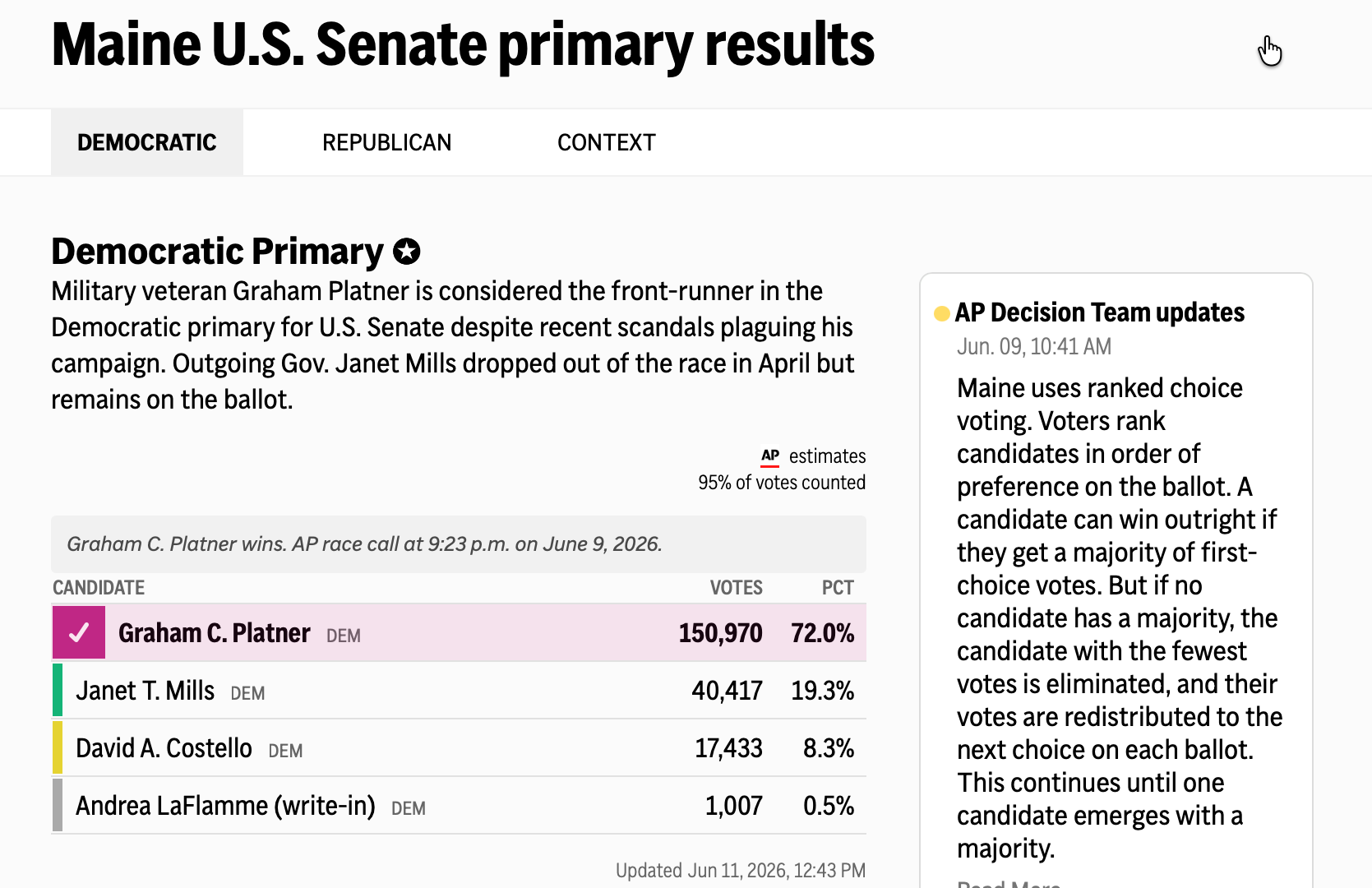
Winning 72% of the vote under those circumstances would have looked pretty darn good.
When Mills suspended her campaign, and the Times and Journal stories hadn’t yet dropped, I imagined Platner potentially hitting a primary vote total north of 80%. Those stories, and all the coverage that followed, changed the calculus of course. It threw the Platner campaign onto the defensive, forcing it to bring in surrogates and spend time and resources beating back the negative press.
Yet, Platner still managed to win the support of 72% of Maine Democrats.
A weaker performance—say winning only 60% of the primary vote—would have certainly led to days of recriminations about hopelessly divided Maine Democrats and their fatally flawed messenger.
The stronger showing by Platner beat back those narratives a bit, though recent reporting by Puck suggests establishment Democrats in Washington and around the country remain uneasy with his candidacy
A look back at the 2020 exit polls provides some context.
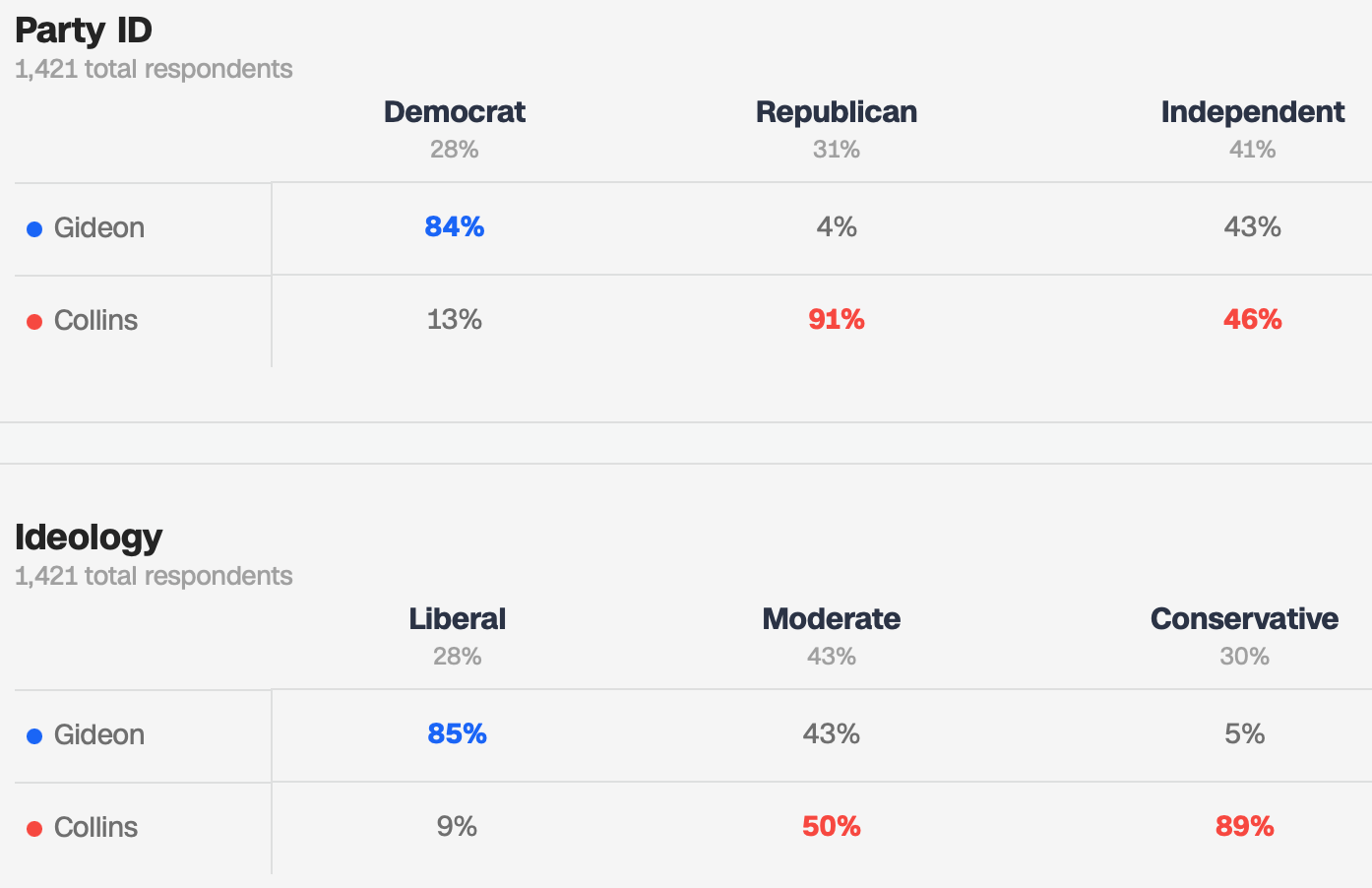
Sara Gideon’s inability to lock down the Democratic vote in 2020—in a way comparable to Senator Collins’s hold on Republicans—made the race an uphill climb despite a year’s worth of polls showing Gideon in the lead. In an additional blow, Gideon also narrowly lost Independent or Unenrolled voters to Collins.
2026 is a different cycle with its own unique economic and political dynamics (more on this below) influencing both the composition of the electorate and the issues resonating with Maine voters. No matter how favorable the fundamentals may seem for Democrats right now, Platner and his team would be wise to find a way to win over a majority of the primary voters who backed Maine Governor Janet Mills and David Costello.
This sentence, a few minutes into Platner’s victory speech, suggests the campaign understands the task in from of them.
“Any of those who feel let down, disappointed or disillusioned, it is my job to earn your trust, faith and support. And I will spend every day of this campaign, and if I have the privilege, every day in the United States Senate, doing exactly that.
When Senate Minority Leader Chuck Schumer recruited Janet Mills to run for the Senate last year, he had one specific group of voters in mind. Two recent stories—one on the day after Platner’s primary victory, the other from back in March—lay out this theory of the case.
Women, particularly older women, are considered the voting bloc that decides elections in Maine. In Collins’s previous race, in 2020, women backed Democrat Joe Biden for president by 13 percentage points but also Collins over her Democratic challenger by 5 points, a survey by AP VoteCast found. Women ages 45 and older were even more likely to cross parties, backing Biden by 15 points and Collins by 7 points.
In a general election, Platner’s supporters are likely right that he would inspire more turnout than Mills from younger irregular voters, especially men. But in Maine, that isn’t as relevant as what Mills already has done well — reassure older, reliable voters, especially women. The Maine electorate is among the country’s oldest. In a midterm, about 70% of voters could be 45 or older.
Platner Needs These Collins Voters to Win in Maine, Bloomberg, March 29, 2026
It’s important to note here that there has been fierce disagreement and frustration in Maine over the wide gulf between this type of national analysis, political reporting from New York and Washington on Platner’s personal controversies and the toll they’re taking on his campaign, and what Maine journalists and folks actually engaging in the political process here are seeing everyday on the ground. This excellent piece from the Columbia Journalism Review explores the disconnect with keen observations from the Midcoast Villager’s Alex Seitz-Wald and Kate Clough, editor of the Maine Monitor.
So where does this race go from here?
On June 10th, the day after Platner’s primary win, a memo from the National Republican Senatorial Committee was leaked to multiple news organization. It described Maine as the linchpin in the battle for control of the Senate, noting both the energy behind Platner’s campaign and the fact that he’s raised more money than Collins in each quarter since he entered the race.
The political fundamentals in Maine remain challenging, and it is a fatal mistake to assume Platner is too damaged to win. He is currently leading. Vice President Harris won the state by 7 points, and the National Democrats view this as their only path to regaining control. Senator Collins has won tough races before and can win this one, but only if we meet this moment with total urgency.
Throughout her years in Washington, Senator Collins has carefully nurtured a political identity in Maine as a pragmatic center-right problem solver who uses her power and seniority to benefit constituents by delivering millions of federal dollars annually to fund everything from new firetrucks and emergency services equipment in the state’s smallest towns to research and development and ongoing support for Maine’s largest heritage industries.
Along the way, Collins has been able to continually reassemble a winning electoral coalition of conservative Republicans, Unenrolled voters and center-left Democrats. Most recently, in 2020, she defied a pandemic, President Trump’s unpopularity, and the polls to win reelection easily by reminding voters of her Maine roots and lifelong allegiance and service to her home state, and by defining her opponent, Rhode Island native Sara Gideon, as a tool of the Democratic elite who didn’t really get Maine or its people and who would deprive the state of the advantages that come with having Collins on the Senate Appropriations Committee.
Now chair of Appropriations, Collins and her team appear determined to use a similar playbook in 2026. Since announcing in February, the Collins campaign has been running ads on the problems she’s solved and the funding and services she’s delivered statewide in recent years. Outside groups supportive of her are bolstering that message and handling the other pillar of the strategy: attacking Platner’s controversies, character and progressive politics relentlessly in an effort to disqualify him in the minds of Unenrolled voters and moderate Democrats, especially older women.
Successfully executing this strategy may prove to be much more difficult in 2026. Collins’s governing approach and political brand have been put to the test like never before during Donald Trump’s two terms in the White House. Trump has never been popular in Maine writ large, and Collins has faced the unenviable reality of delivering legislative wins or funding for voters in one part of her coalition or another and then angering those very same voters by supporting a Trump priority or nominee they can’t stand. This campaign, for example, is her first since the Supreme Court decision that overturned Roe v. Wade.
An even bigger problem for Collins is that the issues and fundamentals shaping the race in 2026 are nightmarish for Republicans and make 2020 seem easy by comparison. In 2024, voters kicked the Democrats out and rehired Trump to get inflation and the border under control. Any credit Trump got early on for securing the border vanished in the wake of the broader public revolt over his immigration crackdown and the killings of two U.S. citizens in Minneapolis by federal agents.
Prices for groceries and other staples remained high even before the president made the decision to join Israel in waging war on Iran in February. Since then, gas has risen to over $5 a gallon in some parts of the U.S., the price of home heating oil has spiked and inflation has jumped to over 4% for the first time in three years.
Donald Trump was unpopular at the height of the pandemic.
His job approval rating over the past year has plummeted to historic lows.
Trump has made a bad situation even worse for incumbents on the ballot in his own party. Never mistaken for an empath, the president has fixated on self-aggrandizing projects of grandeur—the White House ballroom, a Triumphal Arch, a UFC cage match on the South Lawn—as the economy squeezes regular folks here in Maine and across the country.
A new estimate by the group AdImpact projects the Collins and Platner campaigns—and outside groups supporting them—will spend nearly $400 million on ads in Maine by November—nearly doubling the amount spent during the race six years ago.
Platner’s ad strategy thus far has been a savvy mixture of biographical spots, and a multifaceted assault against Collins by the campaign and outside groups supporting it
The biography spots tell Platner’s story of growing up in Maine, serving multiple combat tours in the Marine Corps in Iraq and Afghanistan and the role Maine has played in helping him find the mental health support he’s needed to heal from PTSD and other trauma.
Attack ads portray Collins as a rubber stand for all of the things voters can’t stand about Trump 2.0: the Iran War, out of control immigration enforcement, inflation, high gas prices, corruption in the White House, and billionaires lining their pockets while Maine people struggle.
Other ads attack Collins for supporting Trump’s 2nd term agenda, while claiming she’s still a pragmatic moderate voice in Maine. The takeaway: the Susan Collins you (Maine voters) thought you knew and trusted no longer exists.
Platner is a younger change-agent opponent. He’s offering voters a clear contrast: a more consistent check on an unpopular president and his policies and a more progressive role for government in closing the ever expanding wealth inequality gap in America.
Collins is, without a doubt, one of the country’s most resilient politicians, someone used to winning when victory looks impossible.
Polls in the race are tight with most political observers expecting them to remain that way. Despite all of the money being spent on direct mail and TV and digital advertising, the outcome of the race may come down to who shows up to vote in November. In 2020, with Trump on the ballot, Collins pulled out a race that looked out of reach. When Trump is not on the ballot, his voters historically show up in far fewer numbers. If that happens, it would make it much more difficult for the longest serving Republican woman in the U.S. Senate to win another tough race.