

This friend of mine runs a coffee shop. Summer is his busy season. The last couple of summers, when his family takes off to visit his in-laws, my friend invites me over to do the handful of things that men do when their families leave town. A few weeks ago, on a Saturday evening at a little after 6PM, I pulled into his driveway, got out of my car and walked toward the front door carrying a bag with a two-and-a-half-pound tri-tip prepped in the Santa Maria style.
“Have you seen the whale?” he asked, as he greeted me. It was not the question I was expecting from this more sardonic than sentimental friend. I was thinking more along the lines of “What can I pour you?”
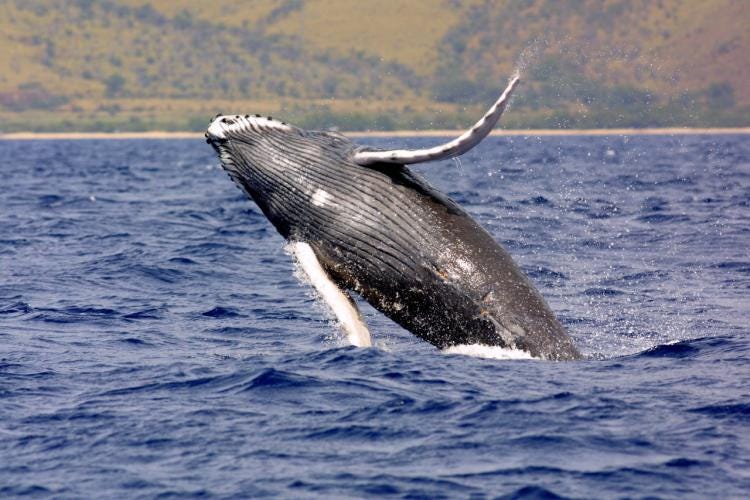
At first, I thought of The Whale, the 2022 film where Brendan Fraser wore a fat suit made of 300 pounds of silicone and latex prosthetics to play a morbidly obese man. I mentioned this to my buddy and we had a laugh. The actual whale, a humpback, had been spotted in the last hour. Ten minutes later, we were standing on a rocky beach at the end of a residential street, drinking Moosehead in a can, staring through binoculars at the windswept bay. We scanned back and forth. After twenty minutes, we gave up.
I live in Midcoast Maine, in a rural county, on a rural road. I travel, on occasion, to other far-flung parts of the state. I’ve dodged many a deer in my vehicle. I’ve spotted moose idling at dusk in roadside bogs. I’ve seen the occasional bobcat bound across a state highway like a world-class hurdler. I’ve spent days in the woods with black bears and the Maine wildlife biologists who track them. I watch game cam videos on the Bangor Daily News website. And I plead guilty to sharing “knucklehead in the woods” videos like the one a year or two ago of some hunter scouting moose up North and getting too close to a bull during the rut: “That’s close enough buddy!” this dude said as the massive, heavy breathing animal showed the whites of its eyes (never good) through a tangle of tree branches before charging him head on. Live here long enough and you’ll have your own wildlife stories to tell around a backyard fire.
The closest I’ve ever come to owning a sea-faring vessel was a few years back. Another friend, no man of the sea, had been gifted a classic 1960s-era fiberglass motorboat. He asked if I (mariner of limited scope) would partner with him on its maintenance, operation, cleaning and storage. I agreed and was made a one percent owner for insurance purposes. Strider, in her own ramshackle way, deepened my appreciation of life in our paradise of a watershed. Drifting, while casting for Stripers, I’ve watched eagles and osprey snatch unsuspecting mackerel from the salt water. I’ve seen seals and porpoises surface and quickly disappear. On occasional paddleboard excursions, the richness of our shorebird community has left me stunned and taken me back to a foundational experience I once had on the water.
Years ago, long before settling on these shores, I went kayaking in Alaska. It was on this trip, a guided thirty-day paddle through Prince William Sound, that I saw my first whale. At the time, whales, as a general concept, were not an object of fascination for me. I’d seen the iconic blue whale at American Museum of Natural History in New York City. I had read Moby Dick in school, concluding, among other things, that sperm whales were fearsome creatures of the sea and best avoided. I was aware, loosely, that I had ancestors who were involved in the whaling industry in New England in the 1700s. I wasn’t convinced this was necessarily a good thing. Whales were a little scary to me if I’m being honest. Scary enough that on that misty afternoon long ago, three quarters of the way through our monthlong paddle across the Sound, my nervous system froze. A pod of orcas had begun following our pod of kayaks. The whales were now moving around and through our small flotilla, showing off their distinctive markings as they surfaced for air and dove back under the dark water. I calmed down enough to appreciate the rare opportunity to see these majestic creatures up close. I paddled on, confident I wouldn’t eaten alive.
In the early evening of July 6, I lay in bed doom scrolling various scathing takedowns of Donald Trump’s perversion of America’s 250th anniversary and transformation of our nation’s capital and its scared places into an unrecognizable, self-aggrandizing armed fortress. On X—special chronicle of our times—rumors were flying about events closer to home.
“Platner cancels multiple events.”
“Platner aides expect damaging story to drop.”
“Likely campaign-ending.”
I went to the Politico website and there it was: the story that would force Graham Platner from the U.S. Senate race. What, if anything, was Maine media reporting? I checked the BDN and saw something far more interesting than Platner and his problems.
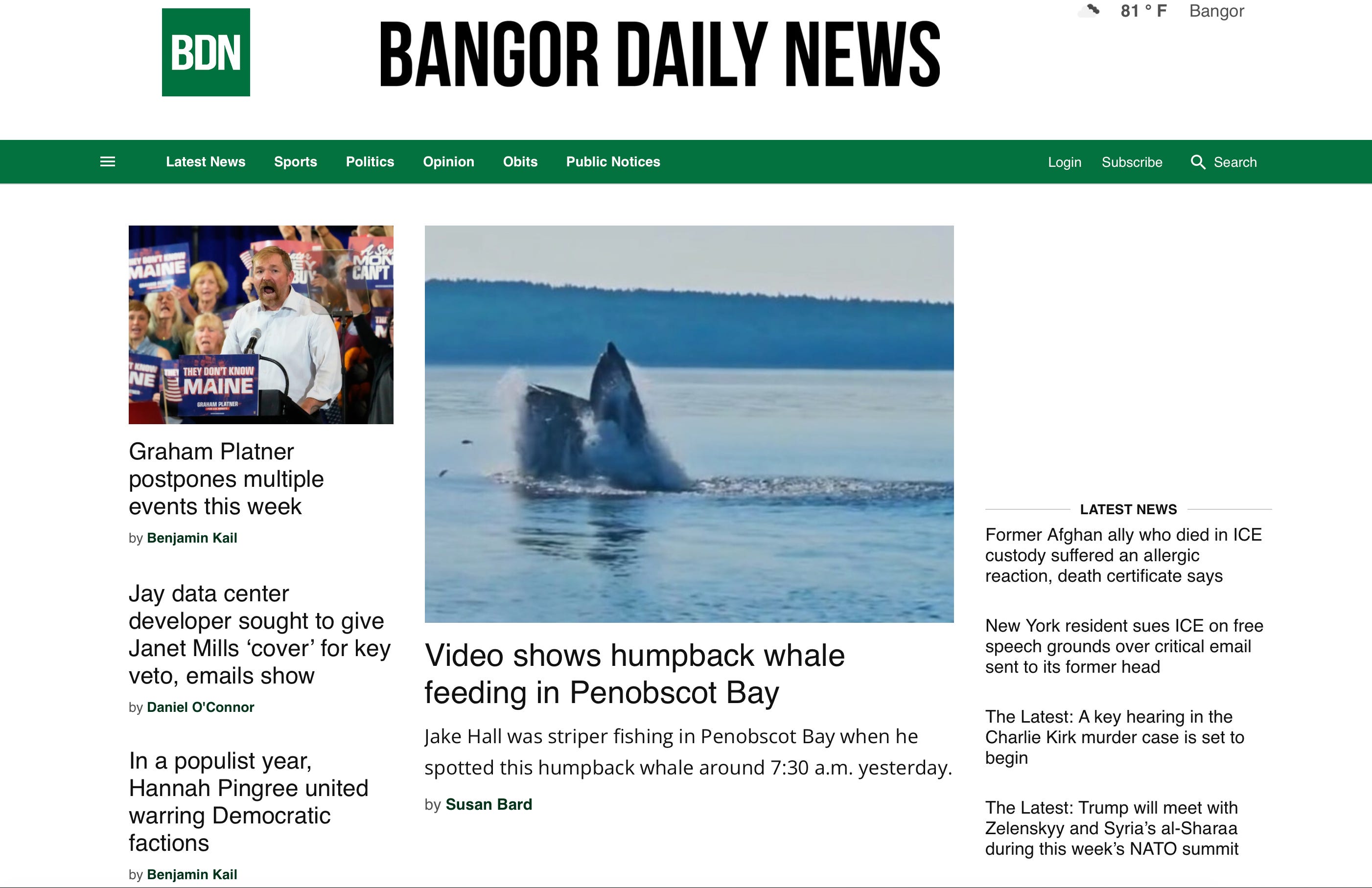
A humpback whale, feeding near your boat, close to shore, doing all the things. I mean, my gosh. I thought you could only see that shit on a whale watch cruise. This was not some pedestrian wildlife encounter through the window of a passing vehicle. It made me wish we still had our boat. Politics being what it is and my mind working the way it does—I turned my attention back to the Platner implosion and forgot all about the whale. Until the next day, when someone else saw it, someone rowing out on bay who recorded an Instagram video of their own encounter.
The whale had entered my consciousness.
I’m online a lot. Building Unorganized Territory this year, with its focus on Maine voters and the midterm election, requires it. It’s easy to get whipsawed and desensitized, almost simultaneously these days, by the endless flow of disturbing news from far away and close to home. July was one slog of a month. Iran, if anyone needed any further convincing, seems destined to go down as one of the great foreign policy failures in our nation’s history. The latest ceasefire agreement—seemingly written on cocktail napkins—fell apart early in the month, underscoring how meaningless the word of the President of the United States has now become, the intractability of the standoff, our civilian leaders mismanagement of it and the risks it continues to pose to global peace and security and the economic fortunes of average Americans. July, the hottest month on record in U.S. history, brought heat domes, drought, wildfires, traveling blobs of wildfire-induced smoke and haze and other reminders of the near and long-term costs of climate science denialism. And on Monday July 13th a Maine-based ICE agent with only 42 days of training and a history of mental instability and violence raised a pistol and fired five shots though the windshield of a White Kia at an intersection in Biddeford killing Johan Sebastian Duran Guerrero, an immigrant from Columbia, a man with a social security number and a valid work permit, a man with a wife and a three-year-old daughter, on his way to work.
Each of these things are upsetting enough on their own. Considering them together, against the backdrop of such an important election in November, can feel overwhelming. How do we stay sane, optimistic even, without becoming people who bury our heads in the sand when the cost of engagement feels too high?
In 1320, settlers began a series of long canoe journeys from East Polynesia to New Zealand. The voyages—multiple trips over thirty years—mark the first settlements on the mainland by the Māori, New Zealand’s largest Polynesian ethnic group. In Māori mythology, whales are supernatural, sacred creatures, descended from Tangaroa, the god of the oceans. The Māori believe whales provide guidance and protection on long voyages across the sea and embody wisdom, strength and an interconnectedness with the natural world.
I’m more skeptic than mystic. America may very well be more divided than at any time since the Civil War. But in these parts, for the past few weeks, a great unifier has come to our shores.
Rowers and paddleboarders. Beachgoers. Strangers in line at the grocery store or the post office. You can see it in their eyes. It’s all whale all the time. When and where they saw it. Their dismay at not seeing it. Or their strategy for seeing it as soon as possible.
Scientists say there may be as many as four humpbacks feeding on this summer’s extra-thick schools of Menhaden along the midcoast.
Whatever.
I prefer to believe it’s just one whale and that it has come for existential reasons too.
Earlier this week, one of my coffee shop pals, a woman who works at the café, said to me “Jay, I thought of you the other day! I finally saw the whale!!”
She had the look of someone under a light spell of some kind. A good spell. A spell I’d like to experience.
I just need to see the whale.
That's an excellent tail, Jay...