

I blocked off July 16th at 7:00 PM on my calendar a few days ago when I learned that would be the start time of the first debate of this new phase of the campaign to be Maine’s Democratic nominee for U.S. Senate. But hours before post time, I wasn’t sure it would even be possible to watch. An early afternoon line of thunderstorms had ripped through the area battering trees, sending limbs crashing down on power lines and knocking out service to thousands in Waldo County. Thankfully, at around half past five, our power returned. I caught up with the day’s news, cranked out some chicken pollo tacos and settled in to watch.
A week is a lifetime in politics.
As tired and well-worn a cliche as this is, it’s true.
Two weeks ago, Maine had a Democratic nominee for U.S. Senate who had won 72% of the primary vote. Today, there are twelve candidates, waging a lightning quick, quasi campaign to convince 601 delegates at a special state convention to make them the nominee to face U.S. Senator Susan Collins in November.
Of the twelve candidates, eight were invited to take part in Thursday’s debate. Only three—Troy Jackson, Nirav Shah and Shenna Bellows—are serious contenders. News Center Maine wisely took that into account in structuring the two-hour debate like a boxing match with a main event and an undercard. The first hour, which I’ll focus on here, featured Jackson, Shah, Bellows and Jordan Wood, who ran third in the recent 2nd District Congressional primary.
Jackson, Shah and Bellows are all battle tested after months on the campaign trail running for governor. But the contest to replace Platner and the face-off versus Collins presents these candidates with an entirely different set of communications challenges.
The Platner Factor
Graham Platner (and the grassroots movement he led) was a turnout machine. He achieved the largest margin of victory in a primary of any U.S. Senate candidate in the state’s history, and he fueled an overall surge in Democratic turnout statewide with some towns recording vote tallies that were more than 100% higher than the total number of previously registered Democrats.
Nearly a month later, as Platner’s campaign crumbled, Troy Jackson, Nirav Shah and Shenna Bellows all quickly called for the nominee to get out of the race, and then immediately joined the contest to replace him.
If Donald Trump is the person likely to have the biggest impact on Susan Collins’s fortunes this fall (outside of the candidate herself), Graham Platner is set to exert a similarly strong influence from the shadows on the campaign of whoever emerges on the Democratic side.
In late May, Platner held a joint press event with Jackson, Bellows and Hannah Pingree, where he announced he’d ranked the three gubernatorial candidates in that exact order on his primary ballot. The hope then was that Democrats up and down the ballot would benefit from the newcomer’s coattails.
Now, Jackson, Bellows and Shah need to find a way engage the Platner energy, while keeping the man and his demons at a distance. News Center Maine gave the candidates a bite at the apple shortly debate got underway.
Whoever replaces Platner will need the fully bought-in energy of his base to have a chance of winning in the fall—even with the strong political headwinds facing Susan Collins.
These answers in this first debate fell flat.
To be fair, these candidates’ heads must still be spinning after running for governor, losing in the primary, jumping into the Senate race on short notice and then facing an immediate leadership test in response to the tragic killing of Johan Sebastián Durán Guerrero by ICE on the streets of Biddeford (more on this below).
But one requirement for taking on Collins must be getting the “Platner question” right. The message has to be more inclusive and dynamic than a candidate simply saying, “Hey, don’t forget, I’ve been fighting for the same structural policy changes for years now!”
Platner, however flawed, caught lightning in a bottle. There was an electricity between the man and his supporters. His progressive populism channeled their deep frustration with the economic state of affairs in America, the nation’s massive wealth inequality gap and the big money command and control of elections under Trump 2.0, a pliant Republican majority in Congress and the establishment wing of the Democratic Party. Those now fighting to replace Platner must open a direct dialogue with his supporters. Acknowledge their pain and disappointment. Praise the energy and engagement he ignited. And make the case that the best way to carry his momentum forward is to unify around the goal of defeating Susan Collins in November.
In his newsletter The Tilt, Nate Cohn, chief political analyst in The New York Times, noted that Platner’s influence on coalition building in the Democratic Party may last a lot longer than his candidacy did.
He went from an unknown candidate to a progressive star who easily defeated his state’s sitting governor in the Democratic primary. This basic underdog story has become familiar in recent years, but Mr. Platner did something that most progressive outsiders haven’t: He was able to appeal across the ideological spectrum of the Democratic primary electorate, even though he was unmistakably a factional candidate of the activist left.
The “Collins=Trump” Contrast
As I noted in my last newsletter, Graham Platner’s withdrawal has likely done little to alter the most important topline findings from the exhaustive NYT/Sienna poll in June on Maine’s Senate race. President Trump’s overall approval rating is underwater. A majority of voters disapprove of his handling of the economy, the Iran War and other key issues and favor electing a Democratic Congress to check a president increasingly seen as incompetent, corrupt and out of control by a majority of the electorate.
Susan Collins is a known entity. No opponent will be able to magically redefine her as a robber baron or a far-right whack job. The goal, while Platner was still her opponent, was twofold. Have Collins-aligned PACs undermine his fitness for office by relentlessly attacking his character and use official campaign ads to remind people, ten times a day, if necessary, how decades of accumulated power and seniority has allowed Collins to direct massive amounts of federal money to every industry, county, city and town in the State of Maine.
For Democrats, the path forward is clear. In addition to bringing along the Platner army, the nominee must deliver a simple and clear message, day after day, that depersonalizes the choice in November and makes it about the risks to you and your family if Republicans retain control of Congress and Donald Trump’s power is left unchecked. A big part of this message is driving contrasts that tie Collins and Trump at the hip on the individual policy areas where Trump’s approval ratings have turned upside down, which is now the majority of domestic policy concerns.
Candidates at Thursday night’s debate all showed an ability to deliver these kinds of contrasts.
The Biddeford ICE Killing
For all of the planning and strategizing that goes into campaigns, sometimes unplanned tragic events, taking place under already charged circumstances, take over the narrative and put candidates under the microscope.
The murder of Johan Sebastian Duran Guerrero by an ICE agent in Biddeford on Monday was as appalling as it was tragic.
Here are the candidates addressing the challenges posed by ICE as it currently operates under the Trump Administration.
Mainers engaged in this year’s election undoubtedly paid close attention this week to how candidates responded to Guerrero’s murder.
Democrats vying to replace Graham Platner were all quick to show up at the many protests in Biddeford and in nearby towns and cities following Monday’s killing.
They spoke out in solidarity with immigrant communities that have been living in fear since ICE first showed up in Maine earlier this year. All the candidates called for abolishing the reimagined version of ICE empowered and set loose under Donald Trump’s immigration agenda.
For Susan Collins, the 48 hours following the Biddeford killing highlighted how little room she has to maneuver in a political year where her eventual opponent is all but certain to attack her for not doing more to oppose Trump’s enforcement and deportation policies.
On Monday, the day of the killing, Collins posted on X that the Department of Homeland Security Secretary, Markwayne Mullin, had informed her that the Boston office of the DHS Inspector General would be launching an investigation in conjunction with the FBI.
On Tuesday afternoon, Collins sent out another update on X.
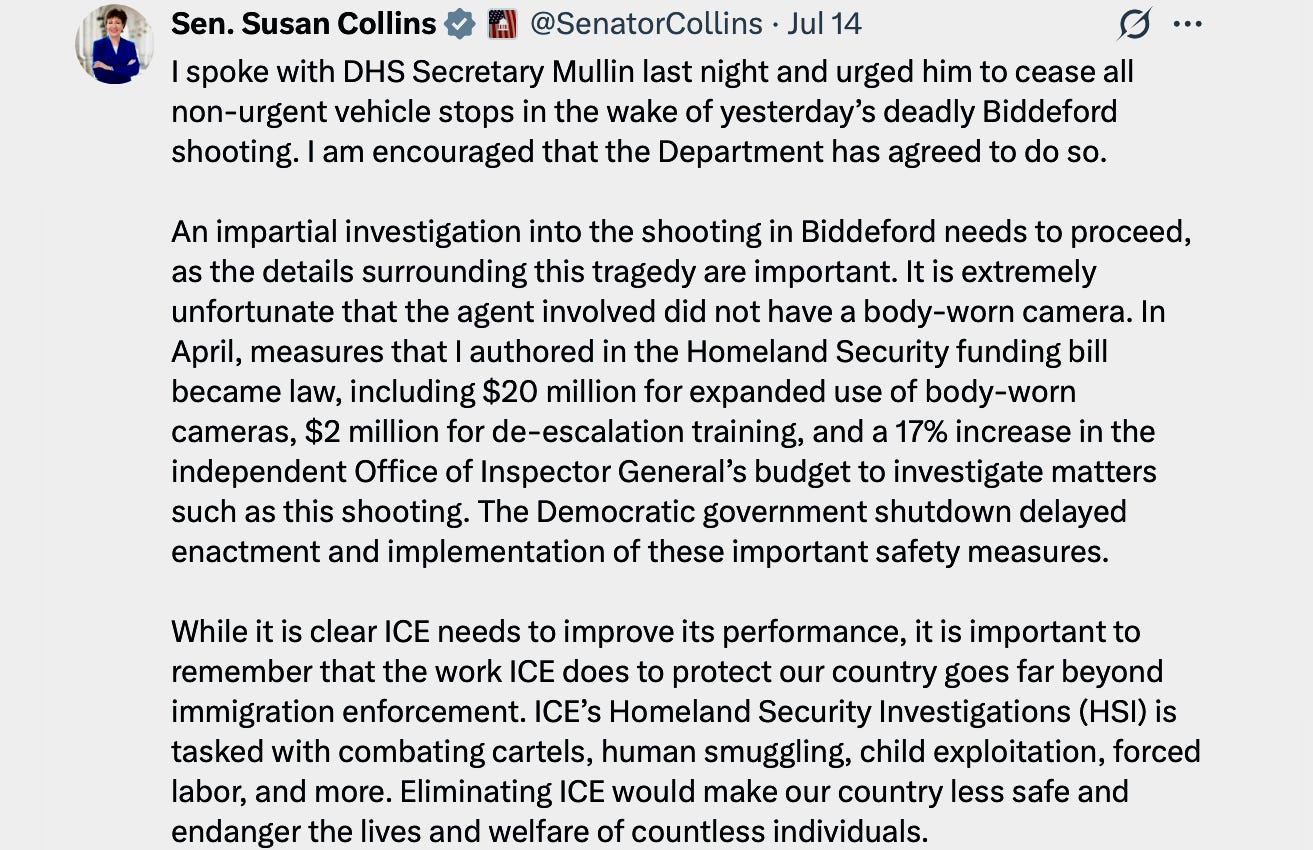
Urging for and delivering a pause on all non-urgent vehicle stops by ICE was a modest political win for Collins.
But it was short lived.
Trump abruptly reversed the pause the next morning in a Truth Social post, demonstrating how little room, politically, he’s willing to give to a member of his own party in a tough re-election fight that’s critical to Republicans hopes of holding the Congress.
As the nominee, Jackson, Shah or Bellows are all likely to use the killing in Biddeford to argue that the costs of sending Collins back to Washington, and keeping the GOP in control of the Senate, are dangerously high.